Blog · Nov 6, 2026 · 10 min read
The Currency Is No Longer a Number

Notes from asi Venice 2026: liquid audiences, the murky middle, and why the next currency will be a governed agreement about reality.
Hannu Verkasalo, Co-Founder & CEO, Behavix · Venice, 6 November 2026
Every second person
Walking into the Hilton Molino Stucky this week felt a bit like walking into a family reunion. You cross the lobby and every second person is someone you have negotiated with, presented next to, lost a tender to, or shared a late Aperol with somewhere in the past fifteen years of asi… All in all, about forty meetings are behind: existing clients, prospective ones, our big global partners, JIC leaders from four continents, and old friends who have been in audience measurement longer than some of the platforms we now have to measure.
That is the real value of asi. The stage is excellent, but the hallway is where the industry decides what it believes. After three days of coffee talks, boat rides and panel sessions, I think it believes something slightly different from a year ago. Let me try to explain what.

Three years, one shifting question
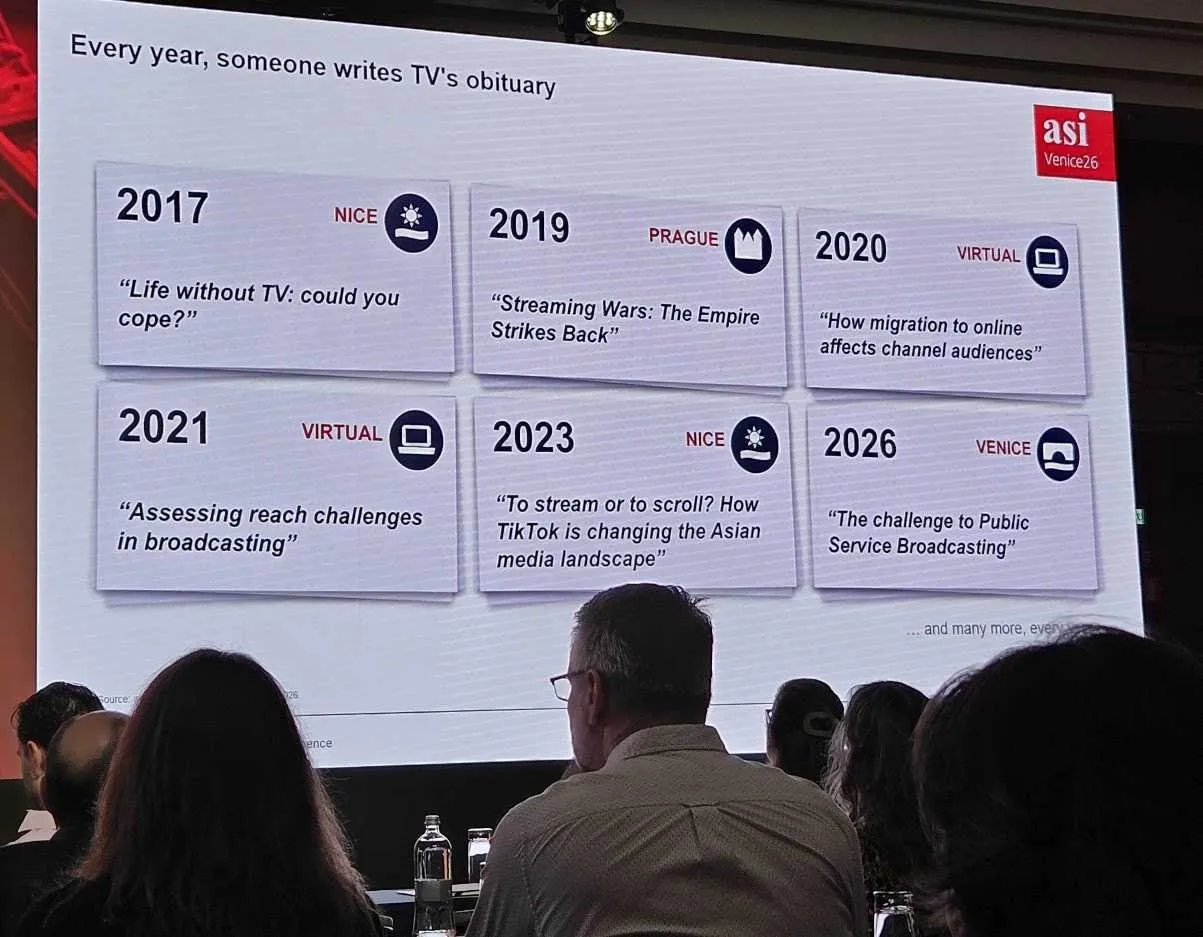
It helps to look at the evolution of asi and its history a bit here. In 2024, here in Venice, the strapline was Video measurement redefined: hybrid measurement, panels versus big data, attention, and the first serious conversation about EU regulation. In 2025 in Copenhagen the theme was Measurement in 2030: AI as beauty or beast, synthetic populations, and the future role of currencies. This year the question on the cover was Audience measurement: beyond exposure and duration? and the session titles tell the story on their own: Who do we trust now?, Navigating TV’s business model in a platform-fragmented world, Measuring people, not platforms, From exposure to impact, and finally The human touch.
In other words, the question has moved from how do we count to what do we count, and who has the legitimacy to turn it into a market truth. That is a much bigger task than improving a meter or anything else in tech or methodology, and it is the task Behavix was founded for.
Liquid audiences and the landing screen
If I had to pick one word that was used in more conversations than any other, it would be liquid. People move from screen to screen, from a broadcaster app to YouTube to TikTok to a podcast to an AI assistant, without ever experiencing those as separate media categories. Households have viewing routines so complex that following everybody, technically and methodologically, is genuinely hard. The TV hardware is still in the living room; what matters is what is on the landing screen when it switches on.
Pierre Fourquet of Ipsos made this concrete with AI analysis of more than 10,000 home-screen images from 3,000 French households: first visibility is a gateway to usage, and availability on a platform guarantees nothing. That mirrors exactly what we have been showing in our own presentations this year. Pierre also smartly mentioned that when AI will be your UI on the TV, it is even more interesting to see how we discover and navigate through content, and what is being recommended or pushed to us… Neil Mortensen’s masked audience at ITV, Chris Colihan-Grillo on Google’s privacy-by-design framework for measuring YouTube, and Lucyna Koba of Nielsen on vertical micro-dramas arriving from Asia into Poland all pointed the same way: the unit of analysis is no longer the channel. It is the person and the journey.
The talk that stayed with me most was Nick North’s Beyond broadcast: the BBC’s role in a connected future. The BBC is YouTube’s biggest single publisher in the UK and has learned, the hard way, that scale alone does not guarantee success on a platform of such abundance. Nick’s points on how a public service broadcaster has to work with YouTube (and Meta and TikTok) to reach new audiences, create genuine incrementality, and attribute what people notice, remember and value back to the BBC were strong and novel. Who owns the content, who distributes it, who controls the user experience and who gets paid are all in flux, and have been for years. The only sensible response is to navigate carefully, and to measure the whole journey rather than defend one island of it.
Seen is not sold
The official theme asked whether we should move beyond exposure and duration. The answer from the Friday morning session was a clear yes, but with discipline. Reach, frequency and time spent are still the grammar of media. They are simply no longer sufficient to explain value when the same minute can be background noise, active discovery, product research or the start of a purchase.
Our friend Owen Hanks of Measure Protocol nailed the problem in Measuring the murky middle: advertising and content measurement share one core challenge, tracking a person’s cross-platform exposure and behavior in the space between an ad and a purchase, and joining TV and streaming exposure to real behavior surfaces roughly double the signal of web-only approaches. Pat Pellegrini of Vividata, in Outcome measures – moving beyond exposure and duration, showed a closed loop from motivational need states through creative resonance to behavioral response. NIQ called it Seen Is Not Sold: elevate reach and frequency from indicators of exposure to indicators of business impact. Ian Garland reminded us that the last click did not create the consumer, and the attention trio of TVision, Nielsen with Adelaide, and Lumen showed that attention is a leading indicator you can act on today rather than months from now.
My own conclusion: outcome measurement must be an additional, auditable layer with observable inputs, not a magic score nobody can interrogate. The trusted audience spine tells us how media was distributed. Cross-platform journeys tell us how it worked.
Different routes, one standard
The most hopeful thing I heard in Venice came from the JICs themselves. AGF and Amazon showed how a global streaming service was integrated into Germany’s standard through a server-to-server route, held to the same granularity, verification, certification and processing rules as everyone else. Mediapulse has cross-platform campaign measurement in Switzerland up and running. Médiamétrie unveiled the foundations of MediaReach. Barb’s Khaled El Serafy asked the right strategic question of hybrid measurement: do you model the panel or model the ratings? Samsung Ads showed how CTV data can complement, rather than compete with, JIC panels.
The phrase I wrote down and underlined was simple: different technical routes, one set of requirements. Panels, SDKs, cloud APIs and server-to-server integrations can coexist as long as every route earns comparability. The JIC of the future is not a technical monopoly. It is the constitutional layer above a plural technology market, holding the market’s definitions while the technology underneath changes.
The human anchor
The closing afternoon could have been a lecture from our own SampleCon recap. Nora Schmitz and Davide Crestani said it plainly: more data is not the same as better measurement, and first-party, device-level or synthetic data is only as trustworthy as the human anchor grounding it. Pete Doe called error the dirty word of research, and he is right that we avoid the conversation. Ben Warner of Electric Twin was refreshingly honest that synthetic audiences are only as good as their seed data. Frances Sheardown shared what 13 to 24 year old panelists in five countries actually think about participating, and Ronny Golan argued that as LLMs create a new generation of walled gardens, consented single-source panels become research’s moat.
AI cannot invent reality. It can simulate, interpolate and extrapolate it, but someone, somewhere, has to measure it. Machines should extend human ground truth, not quietly replace it. The panel may become small relative to the total data volume, but its epistemic importance only grows: it is what connects devices to people, exposes bias and overlap, and gives synthetic systems something real to learn from.
What this means for what we are building
After forty meetings and three days of presentations, the honest feeling is relief. Almost every item on the Venice agenda is a line in the brief we have been building our Behavioral OS against. Cross-platform, real-time, comparable measurement of content and advertising across the open internet and the walled gardens. Depth, not just breadth: not only which app was opened but, where technically and legally possible, what happened inside it, how the session unfolded and how it connected to the rest of the journey. Enrichment, taxonomies people can actually use, and quality control that is explainable rather than magical.
Three things we are doubling down on in 2027 came up in almost every hallway conversation. First, getting the data out: our MCP data feeds put enriched behavioral data straight into analysts’ tools and AI agents, so a JIC, an agency or a brand can build its own ratings, journey models, brand lift reads and competitive dashboards instead of waiting for a quarterly deck. Second, AI assistants and agentic commerce as a measured medium: which assistants people use, for which needs, which brands enter the prompt, and what happens before and after. This is not a side project; it is where the journey increasingly passes through. Third, closing the loop: the phone as the people meter for presence, co-viewing and the connected TV, behavior-triggered micro-surveys that put the why next to the what, and consented commerce outcomes so that exposure finally meets consequence.
Just as important is how we show up. Behavix does not need to replace the ecosystem to improve it. We provide an independent, modular layer that sits beneath existing panels, JIC systems and research partnerships. A JIC keeps ownership of its panel and its data. A panel company can use our meter to build a new shared asset. A prime contractor can combine our behavioral layer with recruitment, weighting, fusion and reporting from other specialists. Markets can test a component before deciding whether it becomes part of a standard. Innovation becomes modular and reversible; the currency stays stable enough to be trusted. That federated model is the business-model innovation this industry needs, and it is how we already work today.
Five things I am taking home from Venice
- Govern before you scale. Define the questions, the rights and the quality gates before you combine every dataset you can reach. Scale without governance is an impressive black box.
- Keep a human anchor. Consented people are the ground truth that everything else, census, ACR, server logs and synthetic populations, must calibrate against.
- Standardize outcomes, not routes. Welcome every collection method that can meet common definitions, audit and certification. Technical plurality is resilience.
- Measure journeys, not channels. TV, streaming, social video, search, commerce and AI assistants belong in one behavioral reality even when they remain separate commercial markets.
- Keep governance local, make innovation global. Media markets are national and cultural; technology is not. JICs can reconcile the two by owning the rules and letting the innovation layer be modular.
Venice is a fitting place for all this. The city works not because everyone takes one route, but because canals, bridges, streets and boats operate inside one shared civic structure. Movement is plural; the city stays legible. Measurement needs the same design. The future currency is not a database. It is a governed agreement about reality.
A sincere thank you to the sponsors who make asi possible: Fifty5Blue, whose team brought three strong papers to the stage this year and sponsored a great “palazzo night” yesterday; Ipsos, for the asi Network Social that opened the week; and Nielsen, the headline sponsor of the TV & Video conference once again. Thanks also to AudienceProject for the Venetian coffee break (and great seeing you Mogens, after all these years… 🙂), dataBreeders for sponsoring the Tony Twyman Award, and Pure X Media for the New Perspectives Award.
And thank you to John McCarthy and the asi team, to the chairs who kept us honest, and to every JIC, platform, broadcaster, vendor and old friend who argued with me in the hallway. Different perspectives are always welcome at asi: JICs defending and challenging methods and vendors, Google and Meta sharing their view of the future, everybody trading opinions over the water. See you in November 2027.

Co-Founder & CEO of Behavix